
Famous Artist Art Lessons for Kids: Van Gogh, Kandinsky, Matisse and More, Without the Copying
9 min read
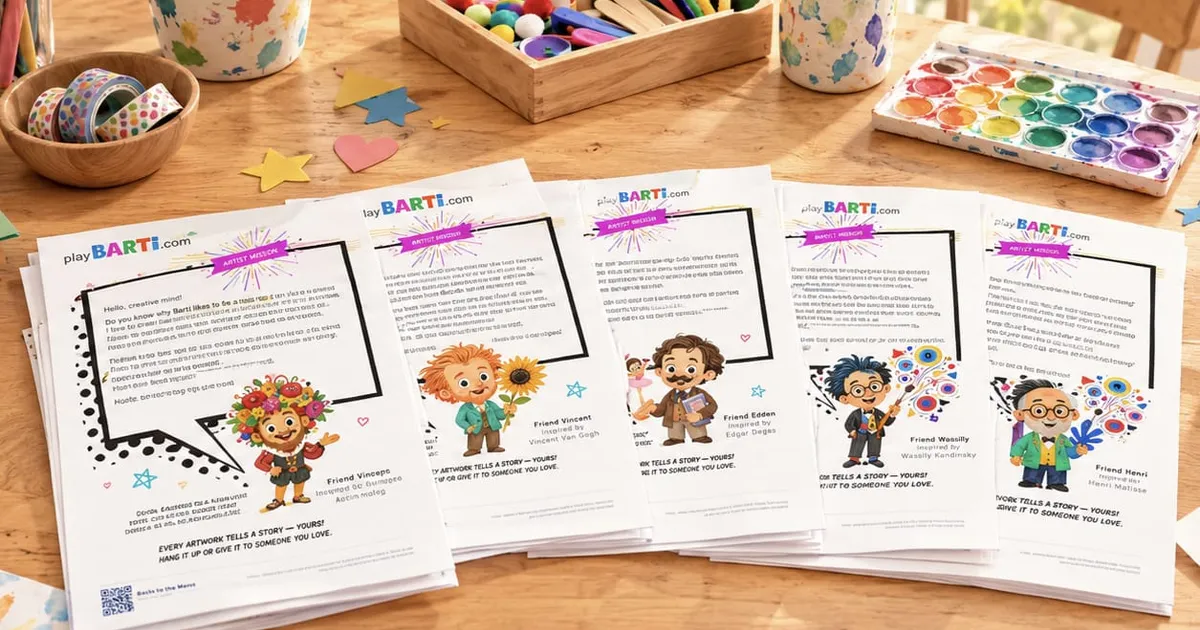
Lessons about famous artists are some of the best-loved in primary art, and some of the most disappointing to display. The plan says Van Gogh; the wall shows thirty careful, slightly wobbly copies of The Starry Night, and the children whose copy went wrong feel they failed at Van Gogh. It doesn't have to work that way. These are the questions teachers ask about teaching art through famous artists, answered by a painter and art educator who has run children's art workshops for more than ten years.
Why copying a masterpiece disappoints
What's wrong with a "copy The Starry Night" art lesson?
Looking at The Starry Night with a class is a wonderful thing to do. Copying it is the problem. Van Gogh painted it in 1889, at the asylum in Saint-Rémy-de-Provence, and when a lesson asks children to reproduce it, success quietly becomes "how close did you get?". Most children can't get close to one of the most famous paintings in the world, the ones who can have mostly practised imitating, and the display ends up as thirty versions of the same picture. The children have followed someone else's decisions, which is almost the opposite of what makes Van Gogh worth studying.
So what can children really take from a famous artist?
One of four things, and one per lesson is plenty: an idea (Kandinsky believed painting could work like music), a way of looking (Degas watched dancers and horses until he understood the moments inside a movement), a technique (Van Gogh's short, repeated, visible brushstrokes) or a story (Matisse, no longer able to paint as he used to, inventing a new way of working with coloured paper). Each of these can travel into a picture that belongs to the child. A finished painting can't.
Should I still show children the original painting?
Yes, and give it time. Ask what they notice before you tell them anything: which way the strokes go, what the picture is made of, where the movement is. The difference is what happens next. The painting starts the conversation; it doesn't stay on the board as the target. In the Barti artist missions the classroom page suggests a reproduction to look at together at the start, and then the attention moves to each child's own work.
Choosing an artist for your class
Which famous artists work best with primary children?
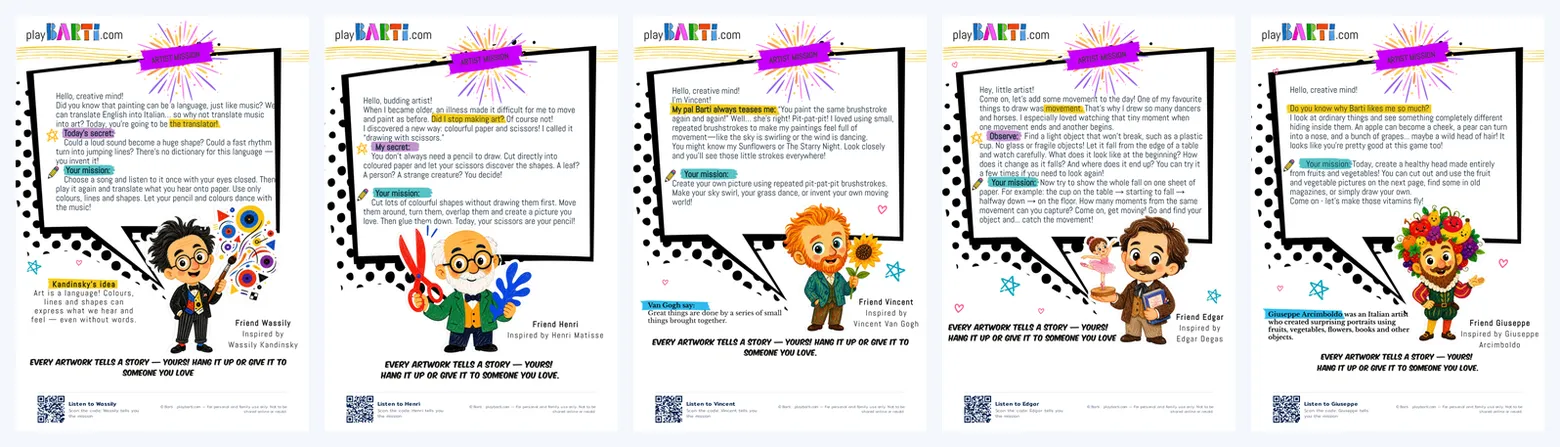
Artists whose way of working fits in one sentence and can be tried with school materials. The Barti artist missions are built on artists like that: Wassily Kandinsky (1866–1944), who treated colour and line like music; Henri Matisse (1869–1954), who made his famous paper cut-outs in the last years of his life; Vincent van Gogh (1853–1890), whose brushstrokes you can see and almost count; Edgar Degas (1834–1917), the painter of dancers and racehorses; and Giuseppe Arcimboldo (around 1526–1593), who painted heads made of fruit, vegetables and flowers. Together they mix abstract and figurative work, paint, paper and pencil, and four centuries of art.
How do I choose an artist for each age group?
With the youngest pupils (Years 1–2), start from artists whose idea is a game or a feeling rather than a skill: Kandinsky's music or Arcimboldo's faces hidden in food work because no technique stands between the child and the idea. Older pupils (Years 5–6) can take more of the artist: a life story, a more demanding way of looking, a technique practised with patience, as with Van Gogh or Degas. In practice the artist matters less than the depth you ask for. All the Barti artist missions are written for ages 6–12, and each guide suggests an easier and a harder version.
Can I teach a Kandinsky lesson in Reception or kindergarten?
Kandinsky's idea is one of the most accessible in art: there is no right shape, and listening comes before drawing. The Barti mission is written for ages 6–12, though, so with four- and five-year-olds you would lead it more yourself and keep it shorter.
What can older pupils take from Van Gogh?
By Year 6 (fifth grade in the US) children are ready for more of the person, not just the painting. Van Gogh only decided to become an artist in 1880, at 27, and painted for about ten years; he wrote hundreds of letters to his brother Theo. Older pupils can take his way of building a picture out of marks and bring it to a subject of their own choosing. That's the heart of the Van Gogh mission: Vincent tells children about his small repeated brushstrokes, and each child uses them in a world of their own.
Introducing an artist
How do I introduce an artist in a few minutes?
One sentence about who and when, one picture, one idea. Children remember a story and a way of working far better than dates and lists of famous works, so lead with the thing they are going to use. In the Barti artist missions the artist does the introducing: scan the QR code on the sheet and Vincent, Henri, Wassily, Edgar or Giuseppe tells the class about the way they worked, in about a minute. The same words are printed on the sheet, so you can also read them aloud.
Do I need to know a lot of art history to teach these lessons?
No. You need a few accurate facts and the ease to say "let's look more closely" when a child asks something you don't know. Each mission gives you the essentials in the guide and on the classroom page, and the artist's own short account is on the sheet. The most valuable part of the lesson, looking at a painting together, needs no expertise at all.
Thirty children, thirty different pictures
How do I stop every child making the same picture?
Give the idea, not the image. If a finished example sits at the front, most children will aim at it, so use the reproduction for looking and talking, and let each child choose their own subject. Talk about decisions ("where did you put the movement?") rather than likeness. Each Barti sheet carries a small "get inspired" illustration, a nudge to get going rather than a model to reproduce, and the guide gives you questions to ask instead of a finished piece to show. When the work goes up, hang it all together, with no "best" picture picked out.
How should I assess an art lesson based on a famous artist?
Look for evidence of the idea, not of the artist. Do the marks repeat and carry movement? Does the picture answer the music? Did the child really watch the movement, or draw what they expected to see? Each Barti classroom page has a short "what to look for" note, and each one also says what not to judge: precision, prettiness or likeness to the original.
Which National Curriculum objectives do artist lessons cover?
The programmes of study ask for them directly: at Key Stage 1 pupils should be taught about the work of a range of artists, craft makers and designers, and at Key Stage 2 about great artists, architects and designers in history. Each Barti classroom page lists its Art and design links, plus other subjects where they fit: Music for Kandinsky, Science for Degas and Arcimboldo, PSHE for Matisse and Kandinsky.
Planning a sequence
How long should a famous-artists unit be?
Five or six weeks, one artist a week, fits a half-term well. One lesson per artist is enough when the lesson is built around a single idea; a second session on the same artist suits older pupils who want to push an idea further. The Artists Pack is a ready-made five-week sequence (Kandinsky, Matisse, Van Gogh, Degas and Arcimboldo), each with its own lesson plan of 35 to 45 minutes. Starting with Kandinsky works well, because music is an easy way in for the whole class.
Why include a sixteenth-century painter next to the modern ones?
Because Arcimboldo shows children that playful seeing is not a modern invention. He was born in Milan, worked as court painter to the Habsburg emperors in Vienna and Prague, and was painting his heads of fruit and vegetables while Elizabeth I was on the English throne. That makes him a good bridge into history, and his pictures are puzzles children want to solve: first you see a face, then you see the pear. In the mission, Giuseppe tells how he saw faces in fruit and vegetables, and each child makes a head of their own.
What's in a Barti artist mission, and what does it cost?
A sheet for the children, where the artist tells the mission (also as a one-minute QR audio), with a small "get inspired" illustration; a guide with materials, questions and an easier and a harder version; and, with the Classroom licence, a page with the lesson plan, group variations, National Curriculum links and display ideas. The Classroom licence, for a single mission or the whole Artists Pack, lets the teacher who buys it photocopy the missions for their own pupils, year after year. There are no videos to stream: a phone to play the audio is enough. For licences, materials and invoices, see our answers for primary teachers.
Can I try a mission before I buy?
Yes. Two full missions are free by e-mail: The Bizarre Characters and What Else Could It Be?. They aren't artist missions, but they let you see a Barti sheet and guide, and hear the audio, in your own classroom before you choose an artist.
Try a free lesson
Print “The Bizarre Characters” with its guide and see how a Barti mission works in your class.
Get the free lessonSent by e-mail. No card needed.