
Ready-Made Art Lessons for Primary Teachers: Open-Ended, Printable and Curriculum-Linked
6 min read
Planning art week after week takes time most teachers don't have. And many ready-made activities end the same way: twenty identical owls on the wall. These are the questions primary teachers ask most, with honest answers about ready-made, open-ended art lessons for children aged 6–12.
Finding art lessons that work
I'm tired of looking for new art lesson ideas every week. Where can I find ready-made art lessons?
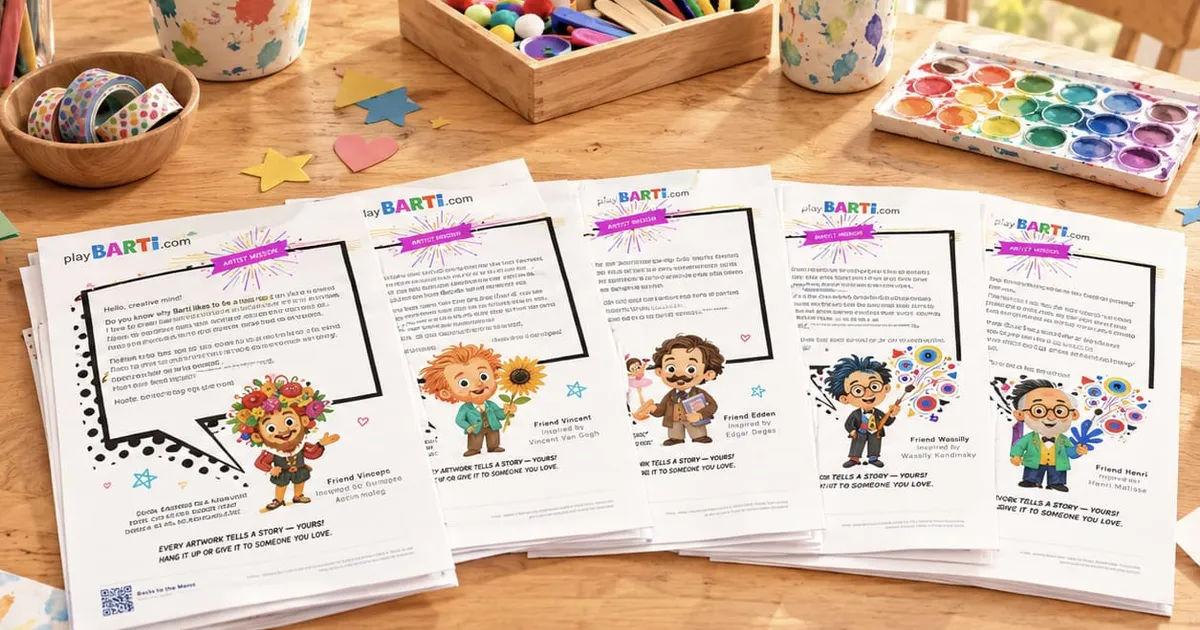
Barti missions are printable art lessons for ages 6–12, ready to use: a mission sheet for the children, a guide for the teacher and a classroom page with a 45-minute lesson plan, group variations and curriculum links. You print, read the plan, and teach.
I want to do something fun and creative with my class that isn't just another worksheet. What can I use?
A worksheet has one right answer. A Barti mission has none: it gives the class a clear starting point (a story, a challenge, a few simple steps) and no model to copy, so every child makes something different. Children listen to the mission through a QR code, which is a good way to start the lesson together.
Are there free, reliable art resources for primary school?
You can try a full mission for free: The Bizarre Characters, sent by e-mail. Barti was created by a painter and art educator who has run creative workshops with more than 3,000 children over more than ten years. Our Ideas section is free to read.
Do I need to be good at art to teach these lessons?
No. The lesson plan tells you how to introduce the mission, how to organise the room and what to look for, and the children's guide does the explaining. Because there is no model to copy, nobody, teacher included, has to draw "well".
Open-ended art in the classroom
What is an open-ended art activity?
An activity that gives children a starting point instead of a finished example: a question, a material, a rule or a small challenge. What they make from it is up to them. Barti missions are semi-structured: enough structure to get started, then the decisions belong to the child.
What is process art, and how is it different from a craft?
| Craft or step-by-step activity | Process art |
|---|---|
| Follows a model | Starts from an idea or a material |
| Results look alike | Every result is different |
| The adult decides when it's "right" | The child decides when it's finished |
Crafts have their place, but if every art activity is a copy, children rarely practise having their own ideas. Process art and open-ended art are close cousins; Barti missions are both.
Does open-ended art work with mixed abilities?
Yes. Because there is no single correct result, every child can succeed in their own way, and the same mission challenges a confident 11-year-old and a hesitant 7-year-old. The guide also suggests an easier and a harder version.
Listening lessons, too
Can pupils listen to the missions?
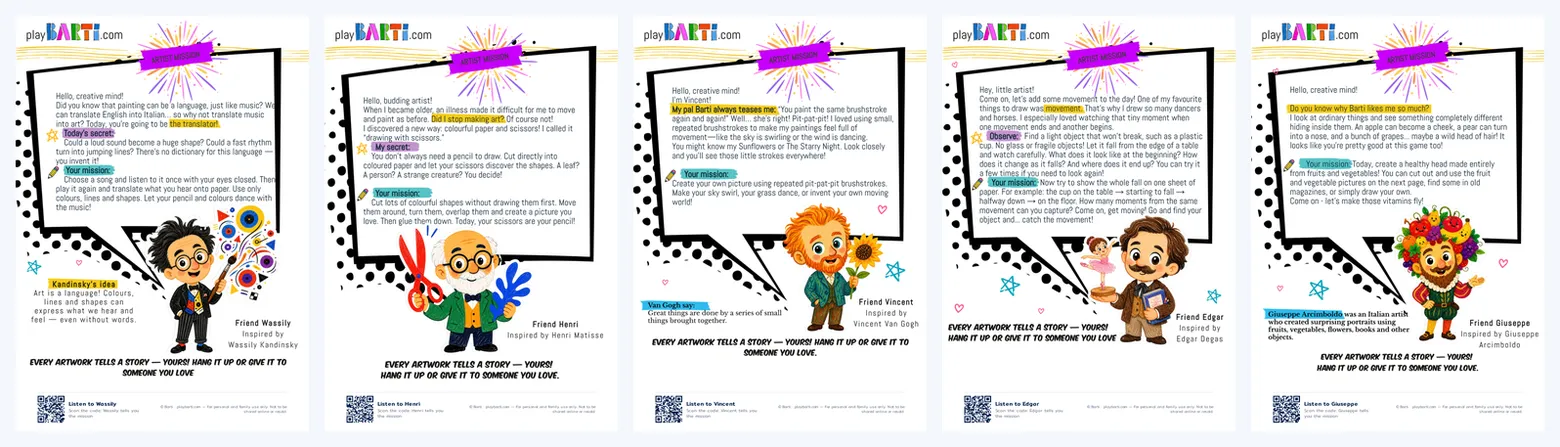
Yes. Every sheet has a QR code: scan it and the mission is read aloud in about a minute, by Barti or, in the artist missions, by the artist. The same mission is written on the sheet, so pupils can listen first and then read along.
Can I use Barti missions in English listening lessons?
Yes, and it makes a listening task with a purpose: children listen to find out what they have to do, then do it. It works for English as a foreign language (EFL/ESL) and for pupils with English as an additional language (EAL). Teachers of Italian can use the Italian versions in the same way; they are sold on the Italian site.
What level of English are the recordings suitable for?
Most missions suit learners at about A2–B1 (CEFR): short sentences, mostly in the present tense, instructions in the imperative and everyday vocabulary, in a recording of about one minute. The artist missions use some past tense, because the artist talks about their life, so they fit B1 a little better. With beginners (A1), play the recording twice and use the written sheet as support.
The practical questions
How long is each lesson, and what's in the plan?
The classroom page gives a 45-minute lesson in four steps (introduction, warm-up, main activity, gallery), with ideas for whole-class and pair work, what to look for, and how to display the work.
Do the lessons link to the National Curriculum?
Yes. Each classroom page lists the links to the National Curriculum for England (KS1–KS2), mainly Art and design, and other subjects where they fit (for example Music in the Kandinsky mission).
What materials do I need? Is it expensive to run?
Simple materials: paper, colours, scissors and glue, plus a few everyday objects. Each mission lists its materials on its page, so you can check them before buying. The sheets work printed in black and white, so photocopying is cheap.
Can I photocopy a mission for my whole class, and use it again next year?
Yes. The Classroom licence (£4.99 per mission) lets the teacher who buys it print and photocopy the mission for their own pupils, year after year, for non-commercial use. Colleagues buy their own licence, and the PDFs may not be shared online.
Can I plan a whole half-term of art?
Yes. The Artists Pack is a ready-made five-week sequence: Kandinsky (music), Matisse (cut paper), Van Gogh (brushstrokes), Degas (movement) and Arcimboldo (faces made of fruit and vegetables). Each artist "tells" the mission through the QR code. Classroom licence: £17.99 for all five.
Can the school get an invoice?
Yes. Write to contact@playbarti.com with the school's details and we'll send a receipt or invoice.
Try a free lesson
Print “The Bizarre Characters” with its guide and see how a Barti mission works in your class.
Get the free lessonSent by e-mail. No card needed.