
Art Lessons by Grade: What Works from Kindergarten to Grade 6 (Reception to Year 6)
8 min read
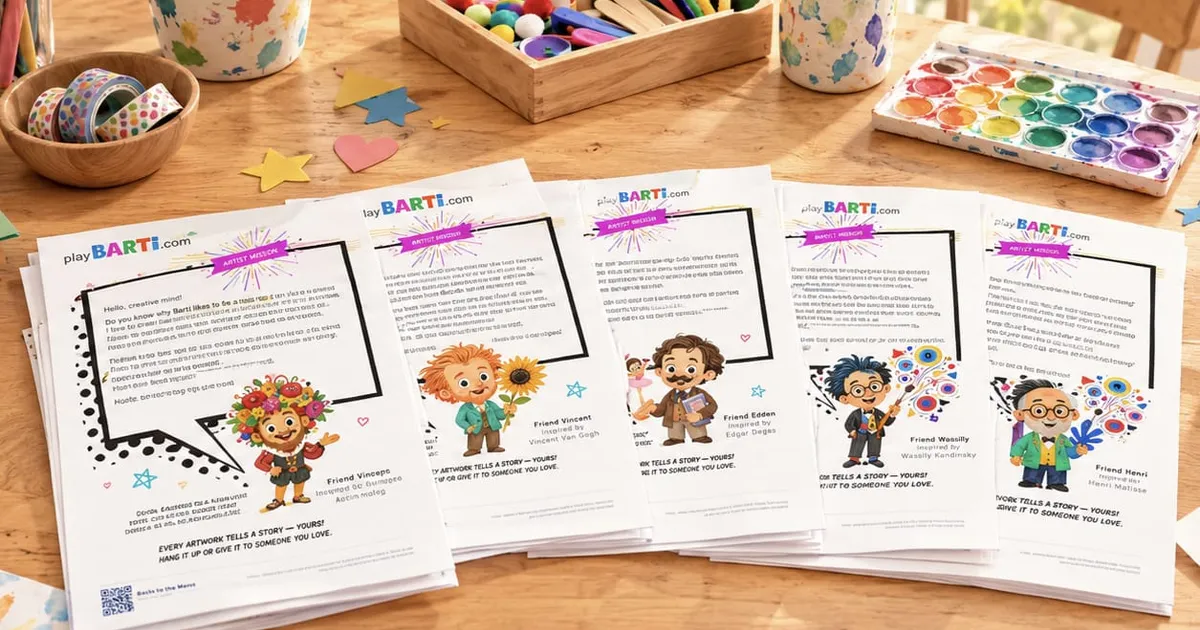
Most art lesson searches start with a grade: "1st grade art lesson", "5th grade art ideas", "Year 3 art", "art activities KS2". The age matters, but perhaps less than the search results suggest. These are the questions elementary and primary teachers ask about art at each age, answered for US grades and UK year groups together, with a pointer to lessons that fit each one.
Finding the right level
How do I find art lessons for my grade or year group?
The Barti missions catalogue can be filtered by age, and each band shows both US grades and UK years: ages 4–5 (Pre-K, kindergarten, Reception), ages 6–7 (Grade 1–2, Year 1–2), ages 8–9 (Grade 3–4, Year 3–4), ages 10–12 (Grade 5–6, Year 6–7) and ages 12–14 (Grade 7–8, Year 8–9). The labels are approximate: a child in Year 4 in England is usually the same age as a child in Grade 3 in the US. If you teach in Scotland, Ireland, Canada or Australia, go by your pupils' age rather than the name of the class.
Why does the same lesson appear under several grades?
Because it is open-ended. A Barti mission gives a starting point and no finished result to copy, so a 6-year-old and an 11-year-old can start from the same sheet and end up somewhere completely different. Many missions work from 4 to 12, and every teacher's guide suggests an easier and a harder version, so you adjust the challenge, not the lesson.
Pre-K, kindergarten and Reception (ages 4–5)
What can kindergarten and Reception children do in an art lesson?
At this age the doing is the point: trying a material, filling a page, turning a shape into something, then telling you what it is. Instructions need to be short and the result should be entirely theirs. Fine motor skills vary enormously within one class, so a good lesson for this age works whether the marks are careful or wild.
Which lessons work for ages 4–5?
The ages 4–5 filter shows the missions written to include them, among them What Else Could It Be? and The Bizarre Characters, both free, plus My Name, My Art and Curious Eyes. Each has an easier version for the youngest. One honest note: the classroom pages link to the National Curriculum for KS1–KS2, not to the EYFS framework, so Reception teachers will make that link themselves.
Grades 1–2 and Years 1–2 (ages 6–7)
What should a 1st or 2nd grade art lesson look like?
A clear start, a lot of choice and very little talking from the front. Children of this age are often keen to begin before you've finished explaining, so the start needs to be quick and easy to follow. On every Barti sheet a QR code plays Barti telling the mission in about a minute; the same text is printed on the paper, so the class can listen together and then look back at the sheet when they forget a step.
How long should an art lesson be?
The classroom page of each mission gives a 45-minute lesson in four steps: introduction, warm-up, main activity and a gallery at the end. Missions vary in length, from 10–20 minutes for What Else Could It Be? to 45–60 minutes for the longest, and every mission page shows its time. With younger classes you can split a longer mission over two sessions; with a short slot, choose one of the short ones. There's more on what the plan contains in our article on ready-made art lessons for primary teachers.
Grades 3–4 and Years 3–4 (ages 8–9)
What makes a good 3rd or 4th grade art lesson?
At this age children can handle a real technique and still make it their own: mixing colours instead of using them straight from the pot, watching movement closely, looking at real animals before inventing new ones. A good lesson gives them something to learn and leaves the decisions to them. That's the shape of missions like The Magic of Colour, Brand New Creature and Degas: Catching Movement.
Can art lessons link to other subjects?
Yes, and the classroom page says where. Kandinsky: Painting Music links to Music, The Magic of Colour to Science (observing and testing), My Name, My Art to English, and What Else Could It Be? to spoken language. The links are written for the National Curriculum for England; teachers following US state standards can use them as a guide to the same skills. If you want to bring in real painters, the Artists Pack has five, one mission each, told by the artist through the QR code: children meet the artist's way of working, not a picture to reproduce.
Grades 5–6 and Years 5–6 (ages 10–12)
What art lessons work for 5th and 6th grade or upper KS2?
Older pupils often want to get better at something specific, especially drawing from observation. The Hand: Seeing Like an Artist was written for ages 10–14: contour, the space between the fingers, simple shapes as Cézanne suggested, searching and confident lines, and a five-tone scale, in 45–60 minutes, with links to KS2 and KS3. Every pupil draws their own hand, so every drawing is different. The open-ended missions still work at this age too, with the harder version from the guide.
Is there anything for Grade 7–8 or Year 8–9?
Yes. The ages 12–14 filter shows the missions written for older pupils, such as The Hand.
Can my class do self-portrait and identity work?
Yes, as long as each child works from themselves. My Name, My Art turns a child's own name into an artwork, Arcimboldo: a Head of Fruit and Veg builds a face out of fruit and vegetables, and The Box of Superpowers is about strengths and feelings.
Across the grades
How do I teach art to a mixed-age or combined class?
Choose a mission that covers the whole age range of your class (the filter shows them) and give the same starting point to everyone. The guide's easier and harder versions let a younger child do less and an older one go further, without anyone working on a different, "baby" task. Because the work is individual and there is no single right result, a split class doesn't need two separate lessons.
What materials does an elementary art lesson need?
Less than you might think. Each mission lists its materials on its page: paper and colours for most, paint for The Magic of Colour, a 2B pencil and a sheet of paper for The Hand. The materials are a starting point, not the result: two children with the same paper and pens will still make two different things. The sheets work printed in black and white.
Is there an example on the sheet for children to copy?
No model to copy. Each sheet has a small "Get inspired" illustration that shows the idea in action, but the mission is written so that every child's result is different from it and from each other's.
How do I assess art without comparing children?
Look at what each child did, not at whose picture is "best". Every classroom page has a "What to look for" note written for that mission: in The Magic of Colour, for example, how much the child experiments, whether they repeat their tests and whether they can explain how they made a colour, not tidiness or a "pretty" page. Compare a child's work with their own earlier work, and in the gallery at the end, put everything up.
Can I use the same lessons with next year's class?
Yes. The Classroom licence lets the teacher who buys it photocopy the mission for their own pupils, year after year, for non-commercial use. It doesn't cover sharing the PDF online or with colleagues. If you run paid workshops outside school, there is a separate Workshop licence.
Start with a free one
The quickest way to see how a mission works in your grade is to try one with your class. What Else Could It Be? takes 10–20 minutes and fits ages 4–12, so it works as a first lesson, an end-of-lesson activity or a cover lesson. The Bizarre Characters takes 20–30 minutes and comes with its own classroom page. Both are free, sent by e-mail, classroom version included.
Barti's missions grew out of more than ten years of art workshops with over 3,000 children, run by the painter Bahar Chirali in Cyprus.
Try a free lesson
Print “The Bizarre Characters” with its guide and see how a Barti mission works in your class.
Get the free lessonSent by e-mail. No card needed.