
Art Sub Plans and Cover Lessons That Work Without You: A Guide for Primary Teachers
8 min read
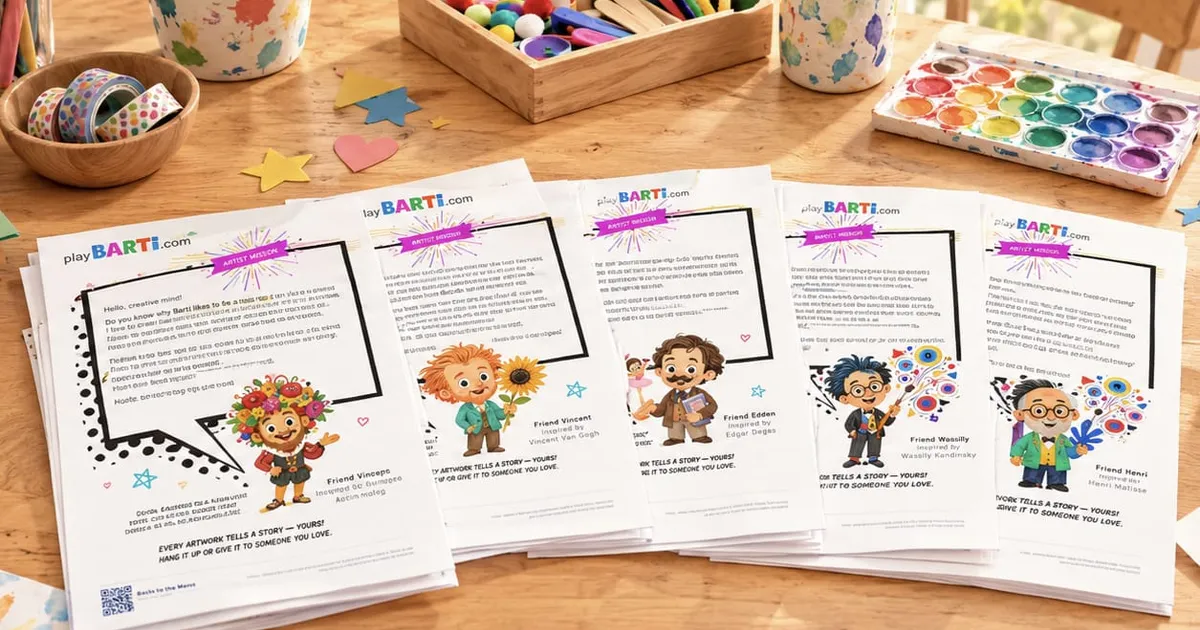
You wake up with a temperature, or a course you booked months ago finally arrives, and someone else will have your class tomorrow. In the US that means writing sub plans; in the UK it means leaving work for a cover supervisor, a supply teacher or the HLTA who takes your PPA time. Either way, art is the lesson most likely to unravel in someone else's hands: paint, mess, a demonstration nobody can give, a video that won't load. These are the questions teachers ask about art sub plans and cover lessons, with honest answers.
What a good art sub plan needs
What makes a good art sub plan for elementary students?
Five things. No preparation for the person covering. One clear starting point they can read out loud. No right answer, so nobody has to judge whether a drawing is "correct". Materials that are already in every classroom. And a length that fits the slot, with a calm ending built in. A plan that ticks all five can be run by anyone, specialist or not, with any class in the school.
Why do so many art cover lessons go wrong?
Usually because the plan depends on the teacher who wrote it. A step-by-step drawing needs someone confident enough to model it on the board. A painting lesson needs someone who knows where the aprons are and how the sinks work. A craft needs a finished example and a demonstration. The person covering has none of that, a class that knows you're away, and often no time to read a long plan before the bell.
Should an art sub plan be a step-by-step drawing?
It's tempting, because it looks safe. In practice it puts the cover teacher in the role of art demonstrator, and the children who fall behind the steps stop, or start copying their neighbour. You come back to twenty versions of the same picture, some finished and some abandoned. An open-ended task works better for cover: the starting point is fixed, the result belongs to each child, and nobody needs to show "how it should look". We explain the difference in more detail in Ready-made art lessons for primary teachers.
Can a non-specialist really run an art lesson?
Yes, if the lesson doesn't rely on the adult's own drawing. Their job becomes handing out, starting, keeping the room calm and collecting the work. This is where Barti missions help: every sheet has a QR code, and when it's scanned, Barti tells the mission out loud in about a minute. The same words are printed on the sheet, so if there's no phone to hand, the cover teacher simply reads it aloud. There is no video and nothing to log in to.
Minimal prep: materials, time and the folder
What materials should I leave for an art cover lesson?
Pencils, colours and paper: what every classroom already has. Leave out paint, anything that needs a lot of glue, and anything with sharp tools. Not because children can't handle them, but because the person covering doesn't know your rules for them. If the plan needs anything beyond the basics, put it in a labelled box with the folder. Every Barti mission lists its materials on its page, and the sheets work printed in black and white, so the photocopier is all you need the day before.
How long should an art sub plan be?
As long as the slot, with a little to spare. A 45 or 60-minute lesson needs one main task with room to go deeper, not three fillers stitched together, because every change of activity is a moment the cover teacher can lose the class. The classroom version of each Barti mission includes a 45-minute lesson plan in four steps, from introduction to a short gallery moment at the end, and the guide suggests an easier and a harder version for children who need them.
What should go in the art sub folder?
The sheets, already counted, with a few spares. The one-page plan. Where the pencils and colours live. How you want the room left and how long tidying up takes. What to do with finished work: names on the back, all in one tray. What early finishers do. And one line that saves a lot of trouble: "There is no right answer, please don't correct the drawings." A cover teacher who knows that won't try to fix a purple sky.
What should I keep for emergency sub plans?
One art lesson, photocopied and left in the drawer, that works with any age in your class and at any time of year. That rules out anything seasonal, anything tied to your current topic, and anything that needs materials you might have run out of. A short mission that only needs pencil and colours is ideal, because it can fill a whole lesson with the easier and harder versions, or just the last ten minutes.
Early finishers and the last ten minutes
What can early finishers do in art without just more of the same work?
Something different and complete in itself. "Do another one" tells a child that finishing early earns more work. A colouring sheet tells them the creative part is over. A better option is a small, separate challenge kept ready in the drawer, which they can start without asking anyone and finish in ten minutes. The classroom page of our free mission suggests exactly that use.
What's a good quick art activity for the last ten minutes of a lesson?
One that needs only a pencil, has nothing to clean up, and ends wherever the bell stops it. What Else Could It Be? was written for that moment: a shape that isn't a picture of anything yet, three different shapes to choose from, and no right answer. It takes 10–20 minutes, suits ages 4–12, and its own guide lists cover lessons, early finishers and the end of a lesson among its uses. It's free, classroom version included.
How do I end an art cover lesson calmly?
Put the ending in the plan, with its own time: the last five minutes, not "if there's time". Work stays on the tables, whoever wants to shows theirs, and then everything goes in the tray. Ask the cover teacher not to pick a "best one" or hold up favourites: with open-ended work every result is different, and there is nothing to rank. A quiet look round the room is enough, and it gives you work to see when you're back.
Using Barti missions as sub plans
Which Barti missions work as art sub plans?
Start with What Else Could It Be? (free, 10–20 minutes, pencil and colours). For a full lesson with nothing but paper and colours, My Name, My Art (30–40 minutes) turns each child's own name into an artwork. If you can leave a box of buttons and bottle tops, Curious Eyes (20–30 minutes) and the free The Bizarre Characters (20–30 minutes) start from small objects dropped or placed on the page. If music can be played in the room, Kandinsky: Painting Music (25–35 minutes) works well. All of these are in the "Few materials" group of the catalogue.
Do they work for K–5, and for 5th grade?
Each mission shows the ages it fits. Most of the ones above suit ages 4–12, which covers pre-K to 6th grade (Reception to Year 7), and Kandinsky suits ages 6–12. For the top end, 5th grade and beyond, The Hand: Seeing Like an Artist is written for ages 10–14 and fills a 45–60 minute lesson with pencil drawing and close looking. Because nothing is copied, the same sheet stretches a confident older child and reassures a younger one.
Do they work for UK cover lessons and PPA cover?
Yes. The classroom page lists links to the National Curriculum for England (KS1–KS2), mainly Art and design, which helps if your school expects cover work to connect to the curriculum. For PPA cover, where the same HLTA or coach takes your class every week, a run of missions gives them a steady, low-prep art slot, and the Artists Pack is a ready five-week sequence.
Can I photocopy the missions and leave them in the cover folder?
Yes, for your own class. The Classroom licence lets the teacher who buys it print and photocopy the mission for their own pupils, year after year, for non-commercial use. It's personal, so colleagues and supply teachers who want to use a mission with their own classes buy their own licence, and the PDFs may not be shared online. The free mission comes with its classroom version, so you can photocopy it for your class too.
Who makes Barti?
Barti was created by a painter who ran children's art workshops in Cyprus for more than ten years, with more than 3,000 children. Every mission comes from that work: a clear starting point, simple materials, and a result that belongs to the child.
Try it before you need it
The best time to test a cover lesson is on an ordinary day, when you're in the room. Print What Else Could It Be?, run it in the last ten minutes of a lesson, and you'll know whether it belongs in your folder. We'll send it by e-mail, with its classroom page.
Get What Else Could It Be? free · For teachers · See all missions
Try a free lesson
Print “The Bizarre Characters” with its guide and see how a Barti mission works in your class.
Get the free lessonSent by e-mail. No card needed.